
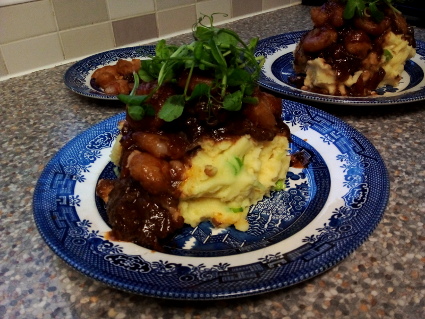
Sat looking lonesome in the Yellow Stick fridge I spotted a couple of packs of Ox Cheek on Thursday. Perhaps not the conventional foundation for a Surf & Turf. But when were we conventional?
Ingredients for the ‘Turf’:-
2 Ox Cheeks, cubed
2 Carrots, batoned
2 Medium Onions, diced
2 Cloves of Garlic, minced
500ml of Beef Stock
500ml of Red Wine Stock
2 Tbsp of Tomato Puree
100g of (Gluten free) Plain Flour
1 Tsp Dried Thyme
2 Bay Leaves
1 Tsp of Red Wine Vinegar
Olive Oil & A nob of Butter / Margarine
1 Tsp of Oyster Sauce
Salt & Pepper to seasoned
Method:-
(1) Flour the Ox Cheeks and fry to brown on all sides in the Olive Oil & Butter.
(2) Remove and set aside.
(3) Season the Onions with Salt And Pepper and fry until translucent and then add the Garlic and stir.
(4) Add the Carrots and fry to soften.
(5) Stir in the Beef and Red Wine stock.
(6) Stir in the Tomato Puree.
(7) Put the Ox Cheeks back in.
(8) Add the Thyme and Bay Leaves and Oyster Sauce.
(9) Simmer for 10 minutes and then transfer to a casserole dish.
(10) Pop in the oven and cook at 160c for about 4 hours until the Ox Cheeks is very tender.
Ingredients for the ‘Surf’:-
200g of King Prawns
2 Eggs
Plain Flour (Gluten free for us)
Soda Water
Garlic Salt
Onion Salt
Turmeric
Additional flour
1 Egg, whisked for an Egg wash
Method:-
(1) Mix the batter ingredients with enough Soda Water to make a reasonably stiff batter.
(2) Heat the fryer to 180c.
(3) Dunk the Prawns individually in Egg wash and the Flour.
(4) Dip in the batter to coat evenly.
(5) Fry individually and once browned slightly drain on kitchen paper.
To serve we made a Spring Onion mash, added the Ox Cheeks first. Stacked the battered Prawn on top and the poured the casserole over the top. A bit of Peas-shoot salad to dress and ‘Jobs a good un’!


