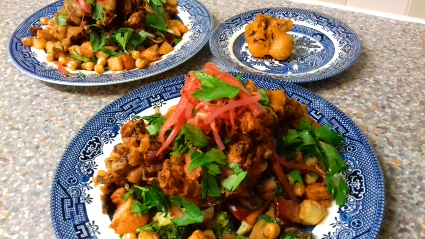
 Cheats because we didn't have 4 hours to spare so Sue accelerated the cooking time – see below.... We raided the local Polish Deli and happened across some Kielbasa Jalowcowa which is a type of Polish sausage, usually served as a cold cut. It is made from cuts of lean pork seasoned with pepper, allspice, coriander, and garlic, packed into large casings, and smoked.
Ingredients:-
2 Potatoes pealed, cubed
2 Carrots sliced
¼ of a Swede pealed, cubed
½ a Celeriac pealed, cubed
1 handful of Mushrooms sliced
¼ of a white Cabbage sliced
4 Polish smoked Sausages
1 tin of chopped tomatoes
½ a tube of Tomato purée
1 Red Onion sliced
1 White Onion sliced
Seasoning:-
Mixed herbs
Paprika
Chilli flakes
Garlic salt
Black Pepper
2 cloves of Garlic minced
Method:-
(1) Parboil all the vegetables in salted water.
(2) Place the vegetables in a casserole dish and reserve the salted water.
(3) Add the Onions to the water and season with the Herbs, Garlic salt.
(4) Add the tinned Tomatoes and Tomato Purée and add the mushrooms
(5) Add the Sausage and simmer for 20 minutes or until the sauce has thickened.
(6) Pour the sauce over the vegetables.
(7) Cover with foil and bake for 1 hour at 180c.
(8) Remove the foil for the last 20 minutes.
We served our casserole with Herby Garlic Bread and it was a real 'Winter Warmer' for a cold evening.


